
4 min read
To assist Japanese learners in to discover courses that meet their learning needs
INDUSTRY
EduTech
TIMELINE
Jul 2024 - Present
ROLE
Product Designer

CHALLENGE
The Udemy marketplace presents an extensive array of options, making it difficult for learners in Japan to effectively navigate the site and identify courses that align with their learning objectives.
STRATEGY
Translate research and data into culturally relevant experiences by co-ideating solutions with stakeholders, prioritizing key opportunities, and experimenting iteratively, sharing the most successful outcomes with the global team for feedback and alignment.
RESULT
Improved checkout intent, and Signup rate by facilitating workshop and crafting culturally relevant experience
My Approach

Activity #1 : Synthesis of Data and Research
Research findings
-
Social Proof Dependency : Since online learning is still a relatively new concept in Japan, learners often look to social proof, such as what others are studying or have completed, when deciding which courses to take. They are heavily influenced by popular courses and recommendations based on the actions of similar users.
-
Need for Guidance :Digital literacy levels in Japan are generally low, which means that most learners consider themselves beginners, whether in technical or non-technical subjects. As a result, many learners feel uncertain about how to begin their online learning journey.
-
Language : Japanese learners overwhelmingly prefer to study in Japanese, regardless of whether the subject matter is technical or non-technical. On Udemy, for example, over 80% of Japan users enroll in courses conducted in Japanese.
-
Visually guided Design: Japanese textbooks, especially for technical subjects, are highly visual. Concepts are often simplified and presented using comic-style illustrations. As a result, Japanese learners have come to expect similarly visual and simplified instruction from online learning platforms.

Example of a python text book
-
How popular the course is (social proof)
-
Peer recommendations or testimonials
-
Clarity of course progression and outcomes
-
Ease of navigation and visual appeal
-
Availability of well-structured, beginner-friendly content
The main factors Japanese learners consider when choosing courses include:


Overall, the new visitor statistics are Low
-
Lowest signup rate among the top 10 countries
-
92% of bounce rate after the first page view
Competitor study in Japan
Competitors in Japan offer specific features to help the learner find courses relevant to them, from the homepage

Example Codecamp
Defining Problem
-
The Udemy marketplace presents an extensive array of options, making it difficult for learners in Japan to effectively navigate the site and identify courses that align with their learning objectives.
-
In contrast, Udemy’s competitors provide various entry points on their homepages, offering tailored questions that assist users in finding suitable courses
Why is this important to solve for Japan?
-
We hypothesis that the absence of guided course discovery is leading to lower conversion rates. Enhancing guidance for course discovery could significantly boost conversions in Japan.
-
Currently, we are losing learners to competitors in Japan who offer this capability, which is contributing to a rapid decline in GMV this year. Testing an improved course discovery experience is essential to assess its impact on conversions.
Our goal is to establish a more guided course discovery journey for new visitors to the Udemy Marketplace in Japan, ultimately enhancing conversion rates for both new and existing users.
Extracting User Personas
My Approach
-
Research driven personas
-
Cultural insights over demographics
-
Behavioural Motivations
Impact & Application
-
Guided ideation
-
Validated assumptions
-
Alligned stakeholders
Why its important
-
Assumptions to evidence based design
-
Uncovered cultural barriers missed in global design
-
Created shared language for cross functional decision

Persona 1 - The empowered learners seeking confidence through knowledge

Persona 2 - The future proof strategist

Persona 3 - Hesitant career changer
Defining OKR
-
Mission: Localized product experience for international learners
-
Objective: Help Japanese learners find relevant courses easily
-
Key Results: Increase conversion rate to atleast 1% higher
Final outcome
-
Conduct experiments to validate the proposed solutions, focusing on course finder and browsing experience enhancements.
2. Experiment 1
For the initial version of the feature experiment, our goal is to assess whether an interactive experience that poses questions and provides tailored course recommendations based on user responses positively influences engagement with the CLPs and conversion rates. Depending on the outcomes, we will introduce additional layers to the questions.
The target audience for this version of the Course Finder includes all new and existing visitors to the Japan marketplace, enabling them to select the topics they wish to learn.
Success Criteria:
-
Primary Metric: Enhance the conversion rate on the Japan marketplace.
-
Secondary Metrics:
-
Checkout Intent
-
User Sign-up (for logged-out users)
-
Paid Enrollment (MX)
-
Enrollment (MX)
-
CLPs viewed through module interactions
-
-
Guardrails: Gross Merchandise Value (GMV)
-
Offline Analysis:
-
Funnel page views
-
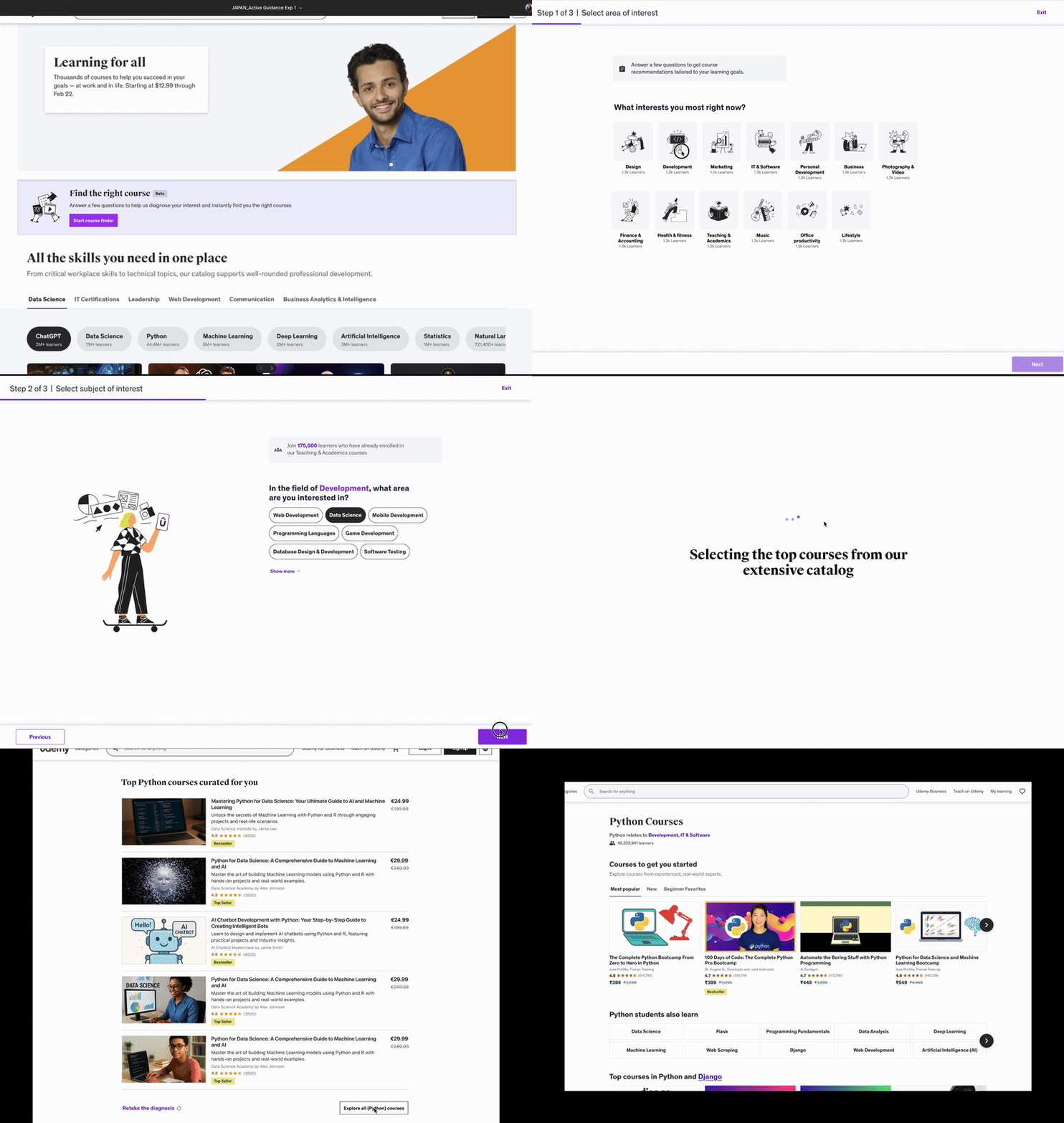
Experiment 1 prototype
Experiment 1 results
Hypothesis
Guided course discovery experience on the Logged-in Homepage (LIHP), Logged-out Homepage(LOHP) and CLP would help users to discover more content and thereby improve purchase conversion.
Duration
Experiment runtime : October 15, 2024 - November 13, 2024
Learned
While our guardrail of GMX MX was fairly neutral, we saw an increase in number of CLPs explored (+16.23%). checkout intent (+2.87%) user sign up (+1.39%). Given these numbers, it was clear that this test had some positive impact on course discovery. Feature open rate = 2.24%. High Conversion rate: 23%
Result :
Treatment not shipped.
Reason :
There is an opportunity to enhance the feature open rate even further in upcoming iterations, which could significantly boost conversions and discovery. Potential factors contributing to the low open rate may include problems with the CTA messaging or its placement/design. These elements could be revised to ensure they are more culturally relevant.
Next Step : A/B Testing
Experiment A
Despite the low open rate observed in the MVP, the impressive conversion rate of 23% in Experiment 1 presents valuable opportunity to enhance both the design and messaging. This could help drive a higher feature open rate.
In this experiment, we have implemented design modifications to the entry points of the feature and expanded these entry points to additional pages within the marketplace for Japan. These pages are considered as landing pages where new users land on to the platform
4 Entry points to improve feature open rate
-
LOHP
-
Search result page
-
Topic page
-
CLP


Experiment A - Entry points
Experiment B
The entry point for this feature will be a floating widget that appears on the landing page when a learner accesses the Udemy platform during a specific session time. This widget is dismissible; users can click the close icon, and it will not reappear until the session time elapses. It will showcase the top three categories along with an outcome-specific prompt designed to engage learners and encourage them to explore the feature.
4 Entry points to improve feature open rate
-
LOHP
-
Search result page
-
Topic page
-
CLP

Experiment B - Visual change and entry point
Note :
The experiment is still running, and we’re awaiting the results.