

A platform for retailer and farmer to connect
YaraBodega
YaraBodega is part of the Yara Digital Farming solution, encompassing various product verticals. It operates as a platform employing a hyperlocal strategy, connecting farmers with retailers. This ecommerce platform allows retailers to establish their stores, enabling farmers to conveniently purchase their agricultural essentials from the nearest retailer.
1
Design brief
YaraBodega was initially introduced as a Minimum Viable Product (MVP) to evaluate and confirm user behavior and market needs. Subsequent versions were then refined based on these insights. The MVP allows farmers to explore the catalog on a web app, choose a shop, and confirm orders through WhatsApp. Recognizing the literacy levels of our target persona, we found WhatsApp to be a more effective interaction tool, incorporating 80% of the functionality.
2
Problems
Findings from qualitative research and data metrics on the MVP guided us in prioritizing significant observations:
- Users encountered challenges in discovering products.
-
Price ranges on products did not adequately support farmers in financial planning.
-
Confusion surfaced during transitions between two distinct apps—WhatsApp and the browser—leading to observed dropouts in metrics
3
My Role : Design sprint facilitator and Lead designer for YaraBodega
The objective is to validate the hypotheses established in the MVP, identify potential opportunities, and generate ideas to further improve them.
4
Process : Design sprint workshop
Why do we conduct Design Sprints? To quickly generate ideas and synchronize priorities with leadership, taking into account both business imperatives and user needs.
1. Mapping
Defined the project's boundaries and crafted user journeys and personas through in-depth research and data analysis. Furthermore, participated in an empathy mapping exercise with a team of five designers.
-
User Personas and Customer Journeys
-
Problem Statements framed as "How might we..."
-
Progressive farmer


-
Traditional farmer


2. How Might We's

2. Ideation
Conducting lightning demos, sketching, and wireframing to generate ideas:
We expediently gathered ideas from team members and iteratively crafted low-fidelity wireframes, refining the design until settling on the final flow. I critically assessed the potential successes and pitfalls of each idea, ultimately determining the optimal flow.

3. Decide
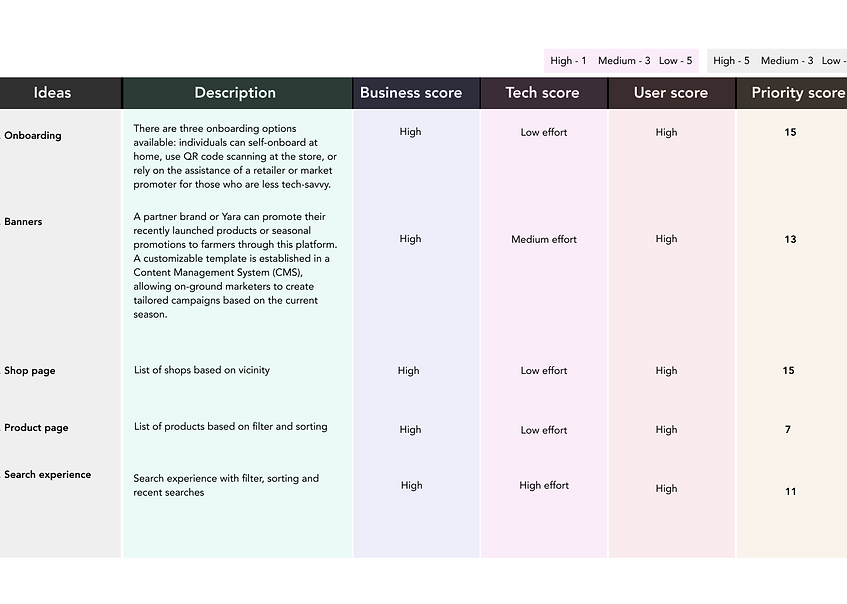
I devised a prioritization scorecard for the ideas, incorporating three key parameters: User score, Business score, and input from the Decider.
4. Prototype
Generated prototypes for various scenarios in collaboration with the internal team, seeking prompt feedback on both usability and visual design.
-
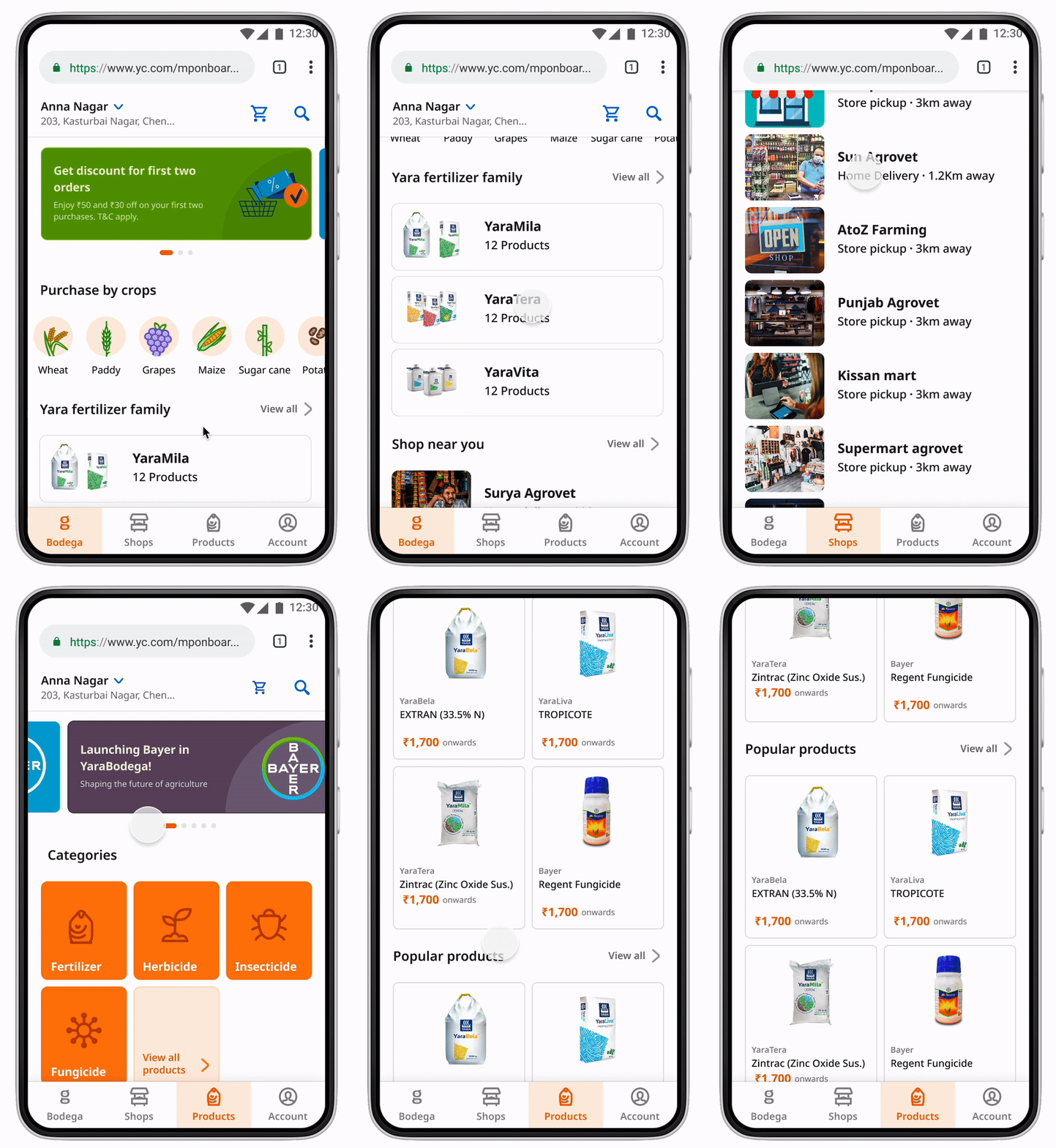
Scenario 1 - farmers receive a YaraBodega URL from friends or family and explore the product experience at their convenience from the comfort of their homes.

-
Scenario 2 - The farmer visits a nearby store, utilizing the store's QR code to browse products and complete the checkout process in-store.


-
Scenario 3 - A farmer with a feature phone is guided through onboarding by a dedicated persona, a Marketing Promoter, who places orders on behalf of the farmer. This model, termed the assisted model, has been implemented in the regions of Kenya.


5. Validation
We rolled out the features in stages across different regions, allowing us to validate our ideas through metrics and on-site field trips.


6. Next steps
Launching YaraBodega 2.0 in three countries—India, Kenya, and Thailand. Continuously monitoring metrics in our Obeya sessions, undertaking field trips, documenting observations, and suggesting enhancements. Additionally, conducting workshops to explore opportunities for expanding YaraBodega as a platform, offering products from partners and additional services like soil tests.
Latest from Jan 2024 - As a change in business KPI, Bodega will be treated as a feature within Yara FarmCare product.